Solar Panel Installation: A Practical Blueprint for Homes and Visual Storytelling
The quiet shift happening on rooftops across entire neighborhoods tells a larger story about energy, economics, and the way we communicate complex ideas. Solar panel installation has moved from an experimental edge case to a widely recognized upgrade for homeowners, landlords, and forward-thinking businesses. At the same time, the way we explain this technology has undergone its own transformation. Enter the minimalist flat design of a solar panel installation scene—a clean, symbolic visual language that powers infographics, blogs, and presentations on green energy. Understanding both the hands-on process and the visual narrative around it helps professionals, creators, and everyday readers make smarter decisions and tell clearer stories.
Unpacking the Installation Process Without the Jargon
Many people still imagine solar panel installation as a bewildering tangle of wires, high-voltage risks, and unapproachable specialists. The reality is far more structured. A typical residential installation follows a defined path that prioritizes safety, structural integrity, and long-term performance. Walking through the stages demystifies the whole operation and reveals why visual aids like flat design diagrams have become so essential.
- Site evaluation and energy audit: An installer assesses roof orientation, pitch, shading from nearby trees, and existing electrical infrastructure. They also review past utility bills to size the system correctly.
- System design and engineering: Using satellite imagery and on-site measurements, technicians map panel placement, inverter location, and conduit runs. This is where a good flat illustration can save a thousand confusing words.
- Permitting and approvals: Local building departments and utility companies review the plan. Paperwork varies by jurisdiction but generally covers structural, electrical, and fire safety codes.
- Physical mounting: Crews secure racking rails to roof rafters, flash mounting points against moisture, and attach panels. The work is methodical—not dramatically different from installing skylights or metal roofing.
- Electrical wiring and inverter connection: DC power flows from panels to an inverter, which converts it to usable AC power. Modern setups often include microinverters or power optimizers per panel for better shade mitigation.
- Grid interconnection and final inspection: The utility installs a bidirectional meter or approves system activation. An inspector verifies the job meets code, and then the switch is flipped.
What surprises most first-time adopters is how quiet the entire system becomes once it is running. There are no moving parts on the roof, no daily maintenance rituals, just a steady stream of electrons that shows up on a monitoring app. This calm, predictable output is part of why clean visual communication pairs so naturally with the technology.
Why Solar Panel Installation Gained Mainstream Momentum Now
The conversation around residential solar used to orbit around early adopters who liked tinkering with lead-acid battery banks. Today the homeowner going solar is more likely to be a remote worker trying to stabilize household expenses or a small business owner insulating against unpredictable rate hikes. Several converging factors explain this acceleration.
First, hardware costs have fallen by more than 80 percent over the last decade and a half, according to industry tracking. Panel efficiency has climbed steadily, meaning the same roof area generates more kilowatt-hours than a system installed ten years ago. Soft costs—things like permitting, labor, and customer acquisition—have become the main frontier for savings, which pushes companies to streamline their messaging. That is precisely where minimalist flat design of a solar panel installation scene becomes a quiet superpower.
Second, utility rate structures are evolving. Time-of-use pricing, demand charges, and the shrinking value of simple net metering credits are shifting the calculus toward self-consumption and storage pairing. People no longer just install panels; they think about whole-home energy strategies. This elevated complexity demands clearer explanations, which static photos of hardware alone cannot deliver.
Third, the cultural signal has changed. A solar array used to broadcast an ideological statement. Now it often simply says, “I ran the numbers and it made sense.” That pragmatic identity aligns with the clean, fuss-free aesthetic of flat vector illustrations that strip away noise and preserve only what matters.
The Rise of Minimalist Flat Design in Green Energy Communication
Minimalist flat design moved from digital product interfaces into technical storytelling because it solves a real communication problem. Photographs of solar panel installation can be visually busy—trucks, ladders, safety gear, reflections, and weather conditions distract from the core message. Flat illustrations, by contrast, use deliberate geometry, restrained color palettes, and simplified forms to direct attention exactly where the narrator wants it.
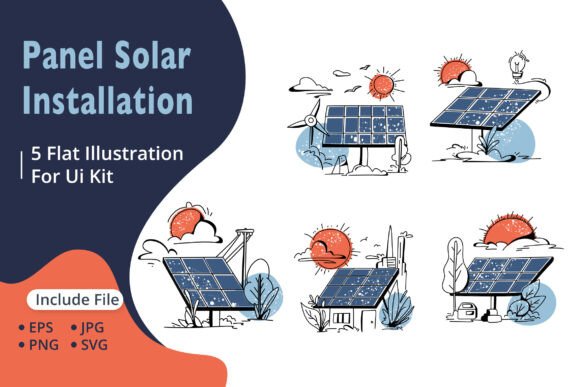
For a solar panel installation scene, that might mean a crisp vector silhouette of a suburban home with symmetrical panel blocks, a sun motif composed of soft amber and pale yellow, and a subtle energy flow line connecting roof to battery to appliance. There are no accidental shadows, no confusing background elements, just the essential story of generation, conversion, and consumption.
Designers and educators embrace this format because it scales effortlessly across mediums. The same scene that anchors an Instagram carousel can become the hero graphic for a utility company’s bill insert or a slide in a municipal sustainability presentation. The visual language stays consistent whether viewed on a four-inch screen or a conference room projector.
Why Creators, Educators, and Businesses Are Adopting Flat Solar Scenes
The shift toward remote learning, virtual sales consultations, and content marketing has amplified the need for assets that communicate clearly without demanding prior technical knowledge. A minimalist flat design of a solar panel installation scene serves multiple audiences at once.
- Educators and trainers: An instructor explaining photovoltaic principles can overlay simple callouts on a flat illustration without the mess of photo backgrounds. Animated sequences showing electron flow feel more intuitive when the base canvas is deliberately uncluttered.
- Bloggers and content creators: Written guides about system sizing or payback periods gain higher engagement when paired with an infographic that visualizes the rooftop layout, inverter logic, and grid connection path. The flat style keeps the page light and scannable.
- Freelancers and design studios: Offering a pack of editable solar panel installation illustrations opens a niche in sustainability consulting, clean-tech startups, and government outreach programs. The demand for such visuals is growing faster than the supply of quality assets.
- Sales and marketing teams: A proposal document that replaces dense technical tables with a clean diagram of panel placement, battery location, and emergency disconnect labeling builds trust faster. Customers feel they understand the system before signing anything.
- Municipal and nonprofit programs: Cities running solarize campaigns or community solar outreach need multilingual, universally readable collateral. Minimalist design travels across language barriers with minimal adaptation.
The beauty of this approach lies in its flexibility. A single well-designed scene can be recolored to match brand guidelines, split into step-by-step modules, or animated for a looping explainer video. The initial investment in quality vector illustration pays off across dozens of use cases.
Design Principles That Make a Solar Flat Scene Effective
Not every flat illustration communicates well. The difference between a forgettable stock graphic and a genuinely helpful visual often comes down to respect for the viewer’s intelligence and attention to real-world accuracy without photographic clutter.
Geometric honesty matters. The tilt angle of panels in the illustration should feel plausible for a residential pitched roof, usually between 15 and 40 degrees. The proportion of panel length to roof surface should echo realistic dimensions. When designers approximate these details, the scene builds credibility instead of feeling like generic clip art.
Color carries meaning. Deep indigo or slate for panels, warm yellow-orange for sunlight, and a crisp teal or leaf green for the energy flow line create instant recognition. Avoid neon overload. The palette should evoke daylight, clarity, and the natural environment without screaming “eco-brochure.”
Negative space earns its keep. Editors and presenters will place text over or around the artwork. A strong flat scene leaves breathing room for headlines, data points, or step numbers. Overcrowded compositions collapse under real-world usage.
Symbolism over literalism. A tiny lightning bolt icon, a simplified battery silhouette, a dashed circular arrow suggesting cycle efficiency—these visual shorthand elements compress explanation time. The best designs guide the eye in a natural Z-pattern: sun to panel to home to grid.
Connecting the Installation Journey to the Visual Narrative
Solar panel installation is not merely an electrical project; it is a transformation of a physical space and a financial relationship with energy. The flat design approach helps bridge the gap between the technical reality and the human experience of that transformation. A well-crafted scene can show before-and-after states, daytime generation followed by evening battery draw, or the seamless integration of panels into different roof styles from Spanish tile to standing-seam metal.
Consider a real-world scenario: a freelance content writer is preparing a blog post for a regional installer targeting suburban families. The article covers federal tax credits, local rebate timelines, and expected production for a 7.2-kilowatt system. Instead of stuffing the page with smartphone photos of mounting rails, the writer embeds a minimalist flat illustration sequence. The first panel shows a bare roof. The second adds racking. The third places panels and routes conduit. The fourth displays the bidirectional meter and a happy household. Readers scroll through the installation journey in seconds, absorbing the emotional arc without a single technical manual reference.
That same scene, recolored and slightly modified, appears the following week in a pitch deck from a clean-tech startup seeking seed funding. Founders use it to explain their installation-as-a-service model to investors who may not have a construction background. The flat design makes the operation look systematic, repeatable, and scalable—exactly the impression a company wants to leave.
The Subtle Power of Uncluttered Visuals in a Noisy Green Market
Green energy marketing often suffers from overcrowding. Competing messages about carbon offsets, kilowatt-hour savings, and payback periods fight for attention. Minimalist flat design offers a counterbalance. It says, “This is simple. This is achievable. This belongs on your roof.”
There is an understated confidence in a single-panel scene with generous white space around it. It suggests the installer or the educator understands the subject well enough to stop overexplaining. Readers feel respected when they are given room to process. In a landscape saturated with hyperbolic stock imagery—families leaping in fields, nebulous glowing hands cradling a globe—the precision of a clean vector installation walkthrough feels refreshingly useful.
For businesses, this restraint translates into higher information retention. A utility survey respondent is more likely to recall the configuration of a home battery system when the infographic stripped away irrelevant details. A city council member reviewing a community solar proposal will grasp the panel arrangement faster from a labeled flat diagram than from a drone photograph full of extraneous visual data.
Practical Tips for Using Solar Flat Design in Your Own Projects
Whether you run a small content site, manage a marketing team, or build presentation decks for clients, integrating minimalist solar scenes does not require deep design expertise. A few guiding habits will keep your usage authentic and effective.
- Start with the user question. Identify the single most confusing step in the solar installation process for your audience. Build a visual answer around that step using clean symbols and limited text callouts.
- Maintain technical plausibility. Even in simplification, do not flip panel orientation upside down or misrepresent conduit paths. Trust erodes when knowledgeable viewers spot lazy inaccuracies.
- Use animation sparingly but powerfully. A gentle pan across a flat roof scene or a fading energy flow line can elevate a presentation without overwhelming the viewer.
- Repurpose across channels. One well-crafted scene can become a blog header, a social media tile, a printed flyer, and a slide graphic. Maintain the core composition and adjust dimensions and color accents as needed.
- Credit the style’s origin thoughtfully. If you license artwork from a designer who specializes in clean-tech illustration, note their work. It builds trust and supports the growing ecosystem of sustainability-focused creatives.
Sustainability Messaging That Feels Grown-Up
There was a time when environmental communication leaned heavily on guilt, urgency, or childlike crayon drawings of the planet. Today’s audiences—especially professionals aged 20 to 50—respond better to a tone that is sober, informed, and solutions-oriented. Minimalist flat design of a solar panel installation scene fits that mature register naturally. It does not plead. It simply lays out a system that works.
Solar panel installation will continue to evolve as permitting bottlenecks ease, virtual site assessments become standard, and installation crews adopt more efficient mounting hardware. The need to explain these changes to homeowners, tenants, investors, and policymakers will not disappear; it will intensify. In that environment, clear visual language becomes not a nice-to-have but a core communication asset.
Designers who invest time in understanding the actual installation workflow—perhaps by shadowing an installer or watching a technical walkthrough—will create far more authentic and useful scenes than those who work from distant imagination. The difference shows in small details: a correctly placed rapid shutdown switch, a genuinely useful gap between panel rows for ventilation, a realistic roof vent relocation. These touches reward attentive viewers and build lasting credibility.
As more of the built environment incorporates solar, battery storage, and smart panel integration, the line between technical documentation and public education blurs. The minimalist flat scene sits comfortably at that intersection, equally at home in a building permit addendum and a popular explainer video. It belongs to installers, educators, marketers, and curious homeowners alike. And it continues to prove that sometimes the most sophisticated way to present a forward-looking technology is with clean shapes, honest proportions, and the courage to leave the rest out.