Visual Storytelling Through Market Economics Infographics: Designing Clarity From Complexity
Economic data rarely speaks for itself. Behind every inflation rate, GDP forecast, or supply curve sits a narrative waiting to be shaped. For anyone who needs to communicate these ideas—whether in a boardroom, a lecture hall, or a startup pitch—the difference between confusion and insight often comes down to how the information is presented. A well-structured visual framework can transform a tangle of numbers into a clear, persuasive argument, especially when it is built on the kind of thoughtfully designed foundation found in a comprehensive Market Economics Keynote Template.
The Challenge of Communicating Economic Concepts
Economics has a reputation for being dense. Abstract models, shifting variables, and interconnected systems create a high barrier for listeners who aren't already fluent in the discipline. When someone opens a presentation slide that is just a bullet-point list of statistics, the audience’s mental effort shifts from understanding to simply decoding. This is where purpose-built infographics make a measurable difference. Instead of asking viewers to reconstruct a supply-and-demand shift in their heads, a clean, animated slide can show the curve moving in real time, the equilibrium point sliding to a new position, and the deadweight loss highlighting itself through color contrast.
The same problem shows up in business strategy discussions. A team debating market entry pricing, elasticity of demand, or competitive responses needs to see those dynamics visually. If the slides are built on a foundation that already incorporates handmade market economics infographics, the presenter can focus on the argument rather than wrestling with diagram construction. This lowers the cognitive load on both sides of the room and makes meetings more productive by default.
Why Template Architecture Matters for Economic Visuals
Not all presentation templates are created equal. A generic business template will give you a slate of basic charts and text boxes, but it won’t offer the kind of specialized structure that economic reasoning demands. The difference becomes obvious when you compare building a supply-demand graph from scratch using shapes and connectors, versus pulling up a pre-built, editable slide that already has the axes, curves, and labeling areas in place. The latter approach saves time and reduces the risk of minor alignment errors that can subtly undermine the professionalism of a presentation.
Templates that are based on Master Slides take this efficiency a step further. With master slide architecture, a single edit to a background element or a font style flows through every slide in the deck automatically. This is especially useful when tailoring a presentation to different institutional brand guidelines or color preferences. A resource that offers 12 color variations on a light background gives you the flexibility to switch from a conservative blue to a more energetic orange scheme without rebuilding anything. Whether you’re an educator preparing a semester-long lecture series or a business professional pitching to multiple clients, this kind of rapid customization keeps your material looking fresh and context-appropriate.
Deconstructing the Slide Ecosystem: 17 Unique Designs That Scale
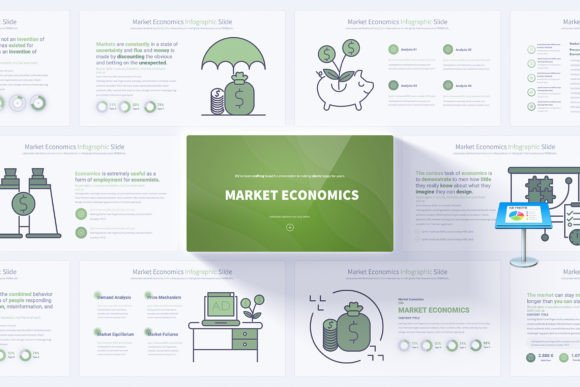
The structure of a presentation is as important as its content. A typical economic talk might need to open with a compelling problem statement, introduce a theoretical framework, walk through data analysis, compare scenarios, and close with actionable recommendations. A Market Economics Keynote Template built around 17 unique Market Economics slides provides distinct layouts for each of these moments, but because there are 204 total slides (multiple versions of each unique design), you never have to stretch a concept-heavy slide into a role it wasn’t designed for.
Consider the types of unique slides you might encounter and how they align with economic storytelling:
- Concept introduction slides: Large, central graphics with minimal text, perfect for introducing key terms like opportunity cost, marginal utility, or comparative advantage. The animated elements can sequence the information so the audience absorbs one part at a time.
- Data comparison layouts: Side-by-side or split-screen designs that let you juxtapose two fiscal policy scenarios, two market outcomes, or historical versus current data. These slides often use subtle color coding from the 12-color palette to differentiate datasets immediately.
- Infographic-heavy process slides: For explaining how a central bank sets interest rates, how a trade imbalance develops, or how a price ceiling creates a shortage. These rely on the handmade infographics to turn a linear description into a visual chain of cause and effect.
- Professional opening and closing slides: Bookend your presentation with credibility. The opening establishes tone, title, and speaker information, while the closing can leave a lasting impression with a summarized key point and a clear call to action.
Because the total slide count reaches 204, you can mix and match the 17 unique designs and their color variants to create a full deck that never feels repetitive. This is particularly important in long seminars or training programs where visual fatigue can set in after the 30th slide. Slight visual variation keeps engagement up without breaking thematic consistency.
The Power of Handmade Infographics in Economics Education
Many presentation templates rely on generic clip art or simplified SmartArt that oversimplifies complex models. A template specifically designed for market economics often includes infographics that were crafted by someone who understands the discipline. These aren't just abstract shapes—they're diagrams of actual economic relationships. You’ll find graphics that illustrate the circular flow of income, the production possibility frontier, the Laffer curve, various market structures (perfect competition versus monopoly), and more. Because these are easily editable elements, you can change numbers, labels, and arrow directions without redrawing anything. This is invaluable for an educator who teaches the same course every year but updates data or tweaks examples each semester.
The handmade quality also means that lines aren’t automatically snapped to rigid, unnatural angles but have a slightly organic flow that makes large technical graphs feel more approachable. That might seem like a minor aesthetic detail, but in practice, a graph that looks too machine-generated can intimidate students or non-specialist stakeholders. An infographic with a human touch can make a GDP breakdown or an inflation dynamics diagram feel like something anyone can understand.
Animation and Transition: Guiding Attention Without Distraction
Static slides have their place, but economic models are inherently dynamic. When explaining how a shift in aggregate demand ripples through an economy, you need to show the sequence. A template that includes animated elements and smooth transitions lets you build a slide piece by piece. An arrow appears when you click, a curve shifts direction on the next click, and a new equilibrium marker settles into place. This controlled reveal is far more effective than displaying a completed, complex diagram from the start and asking the audience to follow your pointer.
These animations, when executed well, are subtle. They shouldn’t bounce, swirl, or distract; they should simply direct the viewer’s eye in the order you intend. In a high-stakes client meeting, this ensures that the CEO or investor is absorbing your argument exactly as you constructed it. With 16:9 Full HD resolution, every animated element remains crisp on large screens, so the visual quality doesn’t degrade in a well-equipped conference room or lecture hall.
Who Benefits Most From a Specialized Economics Template?
While the surface answer is “anyone who presents on economics,” the practical value extends to several distinct groups, each with their own workflows and pain points.
Economists and Policy Analysts: These professionals frequently need to present findings to non-specialist audiences, such as government officials, journalists, or community groups. A template that translates intricate models into clear infographics bridges the expertise gap. They can use the 204 total slides to prepare multiple versions of the same deck—one for a technical audience with detailed data slides, another for a general briefing that emphasizes big-picture infographics.
Business Strategists and Consultants: Whether analyzing market entry opportunities, pricing strategies, or competitive dynamics, consultants live in a world of supply, demand, and elasticity. The ability to quickly customize slides using master slides means that a deck originally prepared for a manufacturing client can be recolored and repurposed for a tech startup in minutes. The bonus 280 fully editable vector icons add another layer of utility: swap in industry-specific symbols without ever leaving the Keynote environment.
University Professors and Teachers: Educators face the unique challenge of building course-long slide decks that must be consistent across weeks but varied enough to hold student attention. With 17 distinct slide layouts and 12 color themes, a professor can design a syllabus presentation, weekly lecture slides, and review session materials that all share a recognizable design language. The easily editable infographics mean that last year’s trade policy example can become this year’s current event discussion with a few label changes.
Students and Graduate Researchers: For a thesis defense, a seminar presentation, or a conference talk, a clean, professional slide deck can make a real difference in how the research is perceived. Many graduate programs don’t offer design training, so a ready-made economics-focused template removes the anxiety of building slides from scratch. The included PDF documentation helps even novice users understand how to make the most of the template’s features quickly.
Hobbyists and Content Creators: A growing number of independent analysts, bloggers, and YouTubers are creating economic commentary for broad audiences. For them, visual credibility matters. Using a professional-grade template signals that the content is serious and well-researched, helping them stand out in a crowded media landscape. The 16:9 Full HD resolution ensures videos and screen recordings look sharp, and the animated elements can be timed during editing to create engaging educational content.
Practical Considerations When Choosing and Using an Economics Template
Templates are tools, and their effectiveness depends on how well they align with your workflow. A useful starting point is to consider the file structure. Templates that are organized around master slides make global changes simple: you can update the footer, logo, or background across every slide at once. This is far superior to templates that treat each slide as a standalone design. If you need to enforce brand consistency across a department or a research group, master slides are non-negotiable.
Another practical factor is color variability. Economics presentations often need to distinguish multiple data series. The 12 color variations on a light background aren't just decorative—they provide a ready-to-use system for highlighting contrasting trends. For example, you might use a blue-themed version for the main narrative, a red-themed version for a section about risks or deficits, and a green-themed version when discussing growth and opportunity. Because all variation slides are drawn from the same unique designs, the overall look remains cohesive even as the mood shifts.
Customization should be straightforward. When a template claims easily editable elements, that means you shouldn’t need to ungroup dozens of shapes, hunt for hidden layers, or struggle with text that doesn’t resize. Ideally, you can click on a chart segment, type a new value, and watch the infographic adjust without breaking. The best templates won’t require you to be a design expert; they’ll let you operate within your area of expertise—the economics itself.
Finally, never overlook the value of a user-friendly guide. A PDF documentation file might seem like a minor addition, but for someone who doesn’t use Keynote daily, clear instructions on how to modify infographics, apply color schemes, or import the bonus icon set can be the difference between a wasted afternoon and a finished presentation in under an hour.
Beyond the Basics: Integrating Real-World Economic Scenarios
A template’s true test comes when you push it beyond its default configurations. Imagine you’re presenting a market analysis of the electric vehicle industry. You could use the supply-demand infographic to show how falling battery costs shift the supply curve right, decreasing equilibrium price. Then, using an animated process slide, you could map the ripple effects: more demand for lithium, shifts in labor markets, policy incentives shifting the demand curve. The variety of slide designs lets you break this complex story into digestible segments without ever leaving the coherent visual world the template creates.
For a consultant advising a government on a sugar tax, the comparison layouts can illustrate deadweight loss, tax revenue, and consumer surplus changes side by side. The color variations allow you to quickly prepare a second, slightly altered version for a stakeholder who responds better to a warmer or cooler visual tone. That sort of rapid iteration isn't a luxury; in many real-world timelines, it’s a necessity.
In educational settings, the same template can serve an entire semester. Week one: the production possibilities frontier. Week five: price elasticity along a linear demand curve. Week ten: comparative advantage and terms of trade. Because the foundation remains consistent, students begin to associate the visual style with economic reasoning itself, which can subliminally reinforce their learning. The availability of 280 fully editable vector icons means you can add illustrative touches—a factory icon for supply-side, a shopping cart for consumer behavior, a globe for trade—without having to source additional assets from elsewhere.
Making Technical Precision Feel Accessible
There’s a delicate balance between accuracy and approachability when presenting economics. Too much detail, and the audience drowns; too little, and you lose credibility. A well-designed infographic template helps you stay on that tightrope. Because the graphs and diagrams are built into the template by someone who already understands market structures, you’re starting from a position of conceptual clarity. You can then edit labels, add your own data, and decide how much supporting text to include. The template doesn’t force a specific level of complexity—it simply provides the scaffolding for whatever level you choose.
The light background across all color variations also contributes to this balance. Dark-themed presentations can feel cinematic but often make reading data labels and smaller text harder, especially in rooms with glare or suboptimal projectors. A clean light background, combined with high-contrast infographic elements, keeps everything legible. When you’re standing in front of an audience and pointing to a specific number on a cost curve, that legibility becomes directly tied to your professional effectiveness.
In a world where economic decisions affect everything from household budgets to international trade policy, the ability to communicate these ideas with clarity isn’t just a professional asset—it’s a form of public service. Whether you’re teaching the next generation, advising decision-makers, or building a business case, the visual layer of your argument will either amplify your message or muffle it. Choosing a specialized resource that combines handmade market economics infographics, flexible master slide architecture, and a broad palette of editability puts the emphasis back where it belongs: on the ideas themselves, presented in a way that people can actually grasp, remember, and act upon.