Submarine Outline Icons: Clear, Minimalist Design for Modern Projects
Icons shape how we navigate information. A sharp, consistent symbol can replace a paragraph of text. That’s exactly why the Submarine Outline Icons set deserves a closer look. Whether you’re building a maritime app, creating a nautical infographic, or just refreshing a website with clean vector illustrations, this collection delivers high‑quality, editable line‑art icons that adapt to almost any creative brief. But simply owning the files isn’t enough — many designers and non‑designers alike make avoidable mistakes that undercut the very clarity these icons offer.
What Makes This Icon Set Different
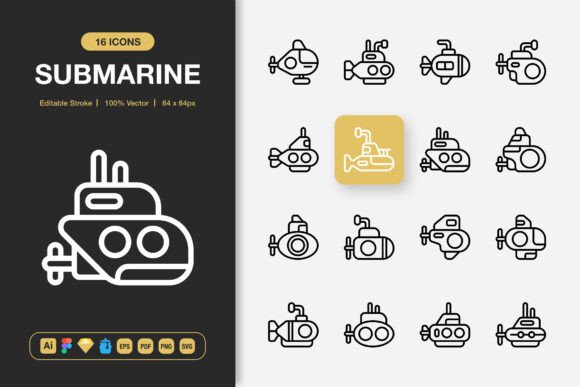
The Submarine Outline Icons bundle isn’t a random assortment of clipart. It’s a coordinated family of minimal, outline‑style submarine shapes, each crafted on a precise grid. The pack includes source files for Adobe Illustrator, Figma, Sketch, and Iconjar, plus universal formats like EPS, PDF, SVG, and a full range of transparent PNG sizes — 32px, 48px, 64px, 96px, 128px, 256px, and 512px. That variety makes the set instantly usable for everything from tiny mobile touch targets to large print posters.
The real strength, though, lies in the editable stroke feature. Unlike static raster images, these icons let you adjust stroke weight, recolor paths, or even simplify a shape without losing crispness. Paired with drag‑and‑drop ease in design tools, you can reposition and prototype in seconds. A humble Readme.txt rounds out the package, containing licensing and usage notes that far too many people skip — and later regret ignoring.
Common Missteps When Using Outline Icon Kits
High‑quality assets don’t guarantee high‑quality results. I’ve seen beautifully designed sites ruined by pixelated icons, mismatched strokes, or blurred symbols because the creator rushed past a few crucial details. Below are the most frequent oversights I encounter, along with straightforward ways to avoid them.
1. Treating All File Types as Interchangeable
A PNG icon resized beyond its native dimensions will look soft or jagged. An SVG, on the other hand, remains razor‑sharp at any size. Many beginners grab a 64px PNG, drop it into a large hero banner, and wonder why it appears fuzzy. If you’re designing for screens, reach for the SVG or native Figma/Sketch components first. Reserve the transparent PNGs for quick layouts, presentation slides, or social media posts where exact dimensions are fixed and you need a lightweight file.
Better approach: Map your use case before downloading. For a website header, use the editable SVG. For a 300‑DPI printed flyer, the EPS or PDF vector will keep edges flawless. The PNG transparency files shine when you’re in a hurry and operating at known pixel dimensions — just make sure you pick the size closest to your final display size.
2. Ignoring the Editable Stroke Feature
A submarine icon in an outline set usually has a default stroke width that may not match your brand’s visual language. Some people import the icon and accept that mismatch, creating a disjointed look across their interface. With the Submarine Outline Icons, you’re not stuck. In Illustrator, Figma, or Sketch, switch the stroke weight from 1px to 2px — or convert the stroke to a clean 0.5pt hairline — in seconds. You can even round caps and joins to soften the silhouette.
Practical tip: If your brand uses thicker line icons (say, 2.5px), apply that same value to every submarine icon in your project. Consistency across all interface elements — from a cart icon to a search glass — gives a polished, professional feel. Don’t let one icon family look like an afterthought.
3. Overlooking Background and Contrast
Outline icons thrive on ample contrast. A light grey submarine line on a pale blue ocean background can become nearly invisible. I’ve reviewed mobile apps where the navigation icons simply disappeared because the creator used the default black‑stroke SVG on a dark mode background without flipping the color. The fix is simple: open any source file, select the strokes, and assign a brighter tint. Since the set is fully customizable, you can also invert fills if needed, though the minimal line style works best with a single color adjustment.
Checklist before publishing: Test the icon on your actual background — white, dark, and busy photo. If you use a PNG, confirm the transparency isn’t baked in with a colored stroke that clashes. Better yet, use the vector files and apply your color in your design tool where you can preview it live.
4. Skipping the Readme.txt and License Terms
I’ve heard horror stories of creators using an icon set freely on a client project, only to discover later that commercial use required attribution or a separate license. The Readme.txt included with this pack outlines exactly what you can and cannot do. It takes two minutes to read, yet skipping it risks copyright notices or last‑minute asset replacements. For small business owners and freelancers, that oversight can damage client trust and even lead to legal trouble.
Advice: Always save a copy of the Readme with your project files. If you pass the assets to a developer, pass the license notes too. This habit protects you and honours the designer’s work. For most standard commercial projects — websites, apps, flyers — the included license is generous, but verifying is your responsibility.
5. Using Mismatched Sizes in the Same Layout
The PNG export sizes in this set are deliberate: 32px for favicons, 64px for standard UI elements, 128px for widgets, and so on. Dragging a 32px icon next to a 128px version in the same row and forcing them to appear identical through CSS scaling usually leads to blurry edges on the smaller one. The Submarine Outline Icons are pixel‑aligned at each size, so rely on the correct resolution from the start. Better yet, use SVG in responsive web design; the browser handles crisp rendering at any container width.
What to do instead: When designing a mobile navigation bar, import the 48px or 64px PNG for mockups, but for development, supply the SVG or the native Figma component. In print, always place the EPS or PDF — never stretch a raster PNG. The extra step saves embarrassment before a client review.
Applying Submarine Outline Icons Across Different Media
Because the pack spans so many formats, it adapts well beyond basic app icons. Educators can drag the sail‑shaped submarines into slide decks to illustrate submarine buoyancy or naval history. Authors of children’s e‑books can place the crisp vectors on chapter headers without worrying about pixelation on high‑resolution tablets. Social media managers can use the 512px PNG on Instagram story templates; the transparency layers cleanly over photos.
However, one overlooked mistake is ignoring the emotional tone of an outline. The minimalist line style communicates modernity and lightness. If your brand identity relies on heavy, filled, retro badges, a delicate submarine outline will feel out of place. The set can still work as a secondary element, but you might need to increase stroke thickness or combine it with a solid background shape. Test a few variations before committing to a campaign.
What to Check Before You Download or Purchase
A great icon set like this one is flexible, but it isn’t a magical fix for a cluttered design. Before you add it to your toolkit, ask yourself a few practical questions.
- Do I have the software to open the source files? The Figma file requires a Figma account (free tier works), Sketch needs a Mac, Illustrator demands a subscription. If you only use browser‑based tools like Canva, the SVG and PNG files will still serve you well, but direct stroke editing won’t be possible. Know your workflow first.
- Will I need to combine these with other icon families? Outline consistency matters. If your project already uses 3px‑stroke icons with rounded corners, you can adjust these submarines to match. But if you lack the time to tweak, seek a set that inherently matches.
- Is the PNG size range sufficient for my needs? The jump from 96px to 128px to 256px covers most use cases, but if you need an exact 200px raster, you’ll have to export from the vector source — that’s easy and keeps quality intact.
- Are the strokes truly editable, or just the whole shape? With this pack, individual paths are accessible. You can delete unnecessary details, like periscope lines, without breaking the icon. Such precision is rare in budget icon sets.
Steering Clear of Cluttered Compositions
A single well‑chosen submarine outline can anchor a login screen or a section header. But packing three different submarine icons side by side, each at a different scale, creates visual noise. Beginners often over‑decorate, thinking more icons mean more meaning. Instead, use one strong symbol that supports the surrounding text. White space around the icon allows the minimal lines to breathe and attract the eye exactly where you want it.
When in doubt, refer back to the editable stroke capability. If you need a variation — perhaps a submarine in a circle, or with a dotted trajectory line — you can duplicate an icon, tweak it, and maintain the same core style. Far better than downloading yet another set that might not align perfectly.
The Long‑Term Value of a Well‑Organized Icon Library
Having the Iconjar file alone transforms asset management. Iconjar lets you search, organize, and drag icons directly into design software without hunting through folders. For a freelancer juggling multiple clients, that
Submarine Outline Icons: Clear, Minimalist Design for Modern Projects
Icons shape how we navigate information. A sharp, consistent symbol can replace a paragraph of text. That’s exactly why the Submarine Outline Icons set deserves a closer look. Whether you’re building a maritime app, creating a nautical infographic, or just refreshing a website with clean vector illustrations, this collection delivers high‑quality, editable line‑art icons that adapt to almost any creative brief. But simply owning the files isn’t enough — many designers and non‑designers alike make avoidable mistakes that undercut the very clarity these icons offer.
What Makes This Icon Set Different
The Submarine Outline Icons bundle isn’t a random assortment of clipart. It’s a coordinated family of minimal, outline‑style submarine shapes, each crafted on a precise grid. The pack includes source files for Adobe Illustrator, Figma, Sketch, and Iconjar, plus universal formats like EPS, PDF, SVG, and a full range of transparent PNG sizes — 32px, 48px, 64px, 96px, 128px, 256px, and 512px. That variety makes the set instantly usable for everything from tiny mobile touch targets to large print posters.
The real strength, though, lies in the editable stroke feature. Unlike static raster images, these icons let you adjust stroke weight, recolor paths, or even simplify a shape without losing crispness. Paired with drag‑and‑drop ease in design tools, you can reposition and prototype in seconds. A humble Readme.txt rounds out the package, containing licensing and usage notes that far too many people skip — and later regret ignoring.
Common Missteps When Using Outline Icon Kits
High‑quality assets don’t guarantee high‑quality results. I’ve seen beautifully designed sites ruined by pixelated icons, mismatched strokes, or blurred symbols because the creator rushed past a few crucial details. Below are the most frequent oversights I encounter, along with straightforward ways to avoid them.
1. Treating All File Types as Interchangeable
A PNG icon resized beyond its native dimensions will look soft or jagged. An SVG, on the other hand, remains razor‑sharp at any size. Many beginners grab a 64px PNG, drop it into a large hero banner, and wonder why it appears fuzzy. If you’re designing for screens, reach for the SVG or native Figma/Sketch components first. Reserve the transparent PNGs for quick layouts, presentation slides, or social media posts where exact dimensions are fixed and you need a lightweight file.
Better approach: Map your use case before downloading. For a website header, use the editable SVG. For a 300‑DPI printed flyer, the EPS or PDF vector will keep edges flawless. The PNG transparency files shine when you’re in a hurry and operating at known pixel dimensions — just make sure you pick the size closest to your final display size.
2. Ignoring the Editable Stroke Feature
A submarine icon in an outline set usually has a default stroke width that may not match your brand’s visual language. Some people import the icon and accept that mismatch, creating a disjointed look across their interface. With the Submarine Outline Icons, you’re not stuck. In Illustrator, Figma, or Sketch, switch the stroke weight from 1px to 2px — or convert the stroke to a clean 0.5pt hairline — in seconds. You can even round caps and joins to soften the silhouette.
Practical tip: If your brand uses thicker line icons (say, 2.5px), apply that same value to every submarine icon in your project. Consistency across all interface elements — from a cart icon to a search glass — gives a polished, professional feel. Don’t let one icon family look like an afterthought.
3. Overlooking Background and Contrast
Outline icons thrive on ample contrast. A light grey submarine line on a pale blue ocean background can become nearly invisible. I’ve reviewed mobile apps where the navigation icons simply disappeared because the creator used the default black‑stroke SVG on a dark mode background without flipping the color. The fix is simple: open any source file, select the strokes, and assign a brighter tint. Since the set is fully customizable, you can also invert fills if needed, though the minimal line style works best with a single color adjustment.
Checklist before publishing: Test the icon on your actual background — white, dark, and busy photo. If you use a PNG, confirm the transparency isn’t baked in with a colored stroke that clashes. Better yet, use the vector files and apply your color in your design tool where you can preview it live.
4. Skipping the Readme.txt and License Terms
I’ve heard horror stories of creators using an icon set freely on a client project, only to discover later that commercial use required attribution or a separate license. The Readme.txt included with this pack outlines exactly what you can and cannot do. It takes two minutes to read, yet skipping it risks copyright notices or last‑minute asset replacements. For small business owners and freelancers, that oversight can damage client trust and even lead to legal trouble.
Advice: Always save a copy of the Readme with your project files. If you pass the assets to a developer, pass the license notes too. This habit protects you and honours the designer’s work. For most standard commercial projects — websites, apps, flyers — the included license is generous, but verifying is your responsibility.
5. Using Mismatched Sizes in the Same Layout
The PNG export sizes in this set are deliberate: 32px for favicons, 64px for standard UI elements, 128px for widgets, and so on. Dragging a 32px icon next to a 128px version in the same row and forcing them to appear identical through CSS scaling usually leads to blurry edges on the smaller one. The Submarine Outline Icons are pixel‑aligned at each size, so rely on the correct resolution from the start. Better yet, use SVG in responsive web design; the browser handles crisp rendering at any container width.
What to do instead: When designing a mobile navigation bar, import the 48px or 64px PNG for mockups, but for development, supply the SVG or the native Figma component. In print, always place the EPS or PDF — never stretch a raster PNG. The extra step saves embarrassment before a client review.
Applying Submarine Outline Icons Across Different Media
Because the pack spans so many formats, it adapts well beyond basic app icons. Educators can drag the sail‑shaped submarines into slide decks to illustrate submarine buoyancy or naval history. Authors of children’s e‑books can place the crisp vectors on chapter headers without worrying about pixelation on high‑resolution tablets. Social media managers can use the 512px PNG on Instagram story templates; the transparency layers cleanly over photos.
However, one overlooked mistake is ignoring the emotional tone of an outline. The minimalist line style communicates modernity and lightness. If your brand identity relies on heavy, filled, retro badges, a delicate submarine outline will feel out of place. The set can still work as a secondary element, but you might need to increase stroke thickness or combine it with a solid background shape. Test a few variations before committing to a campaign.
What to Check Before You Download or Purchase
A great icon set like this one is flexible, but it isn’t a magical fix for a cluttered design. Before you add it to your toolkit, ask yourself a few practical questions.
- Do I have the software to open the source files? The Figma file requires a Figma account (free tier works), Sketch needs a Mac, Illustrator demands a subscription. If you only use browser‑based tools like Canva, the SVG and PNG files will still serve you well, but direct stroke editing won’t be possible. Know your workflow first.
- Will I need to combine these with other icon families? Outline consistency matters. If your project already uses 3px‑stroke icons with rounded corners, you can adjust these submarines to match. But if you lack the time to tweak, seek a set that inherently matches.
- Is the PNG size range sufficient for my needs? The jump from 96px to 128px to 256px covers most use cases, but if you need an exact 200px raster, you’ll have to export from the vector source — that’s easy and keeps quality intact.
- Are the strokes truly editable, or just the whole shape? With this pack, individual paths are accessible. You can delete unnecessary details, like periscope lines, without breaking the icon. Such precision is rare in budget icon sets.
Steering Clear of Cluttered Compositions
A single well‑chosen submarine outline can anchor a login screen or a section header. But packing three different submarine icons side by side, each at a different scale, creates visual noise. Beginners often over‑decorate, thinking more icons mean more meaning. Instead, use one strong symbol that supports the surrounding text. White space around the icon allows the minimal lines to breathe and attract the eye exactly where you want it.
When in doubt, refer back to the editable stroke capability. If you need a variation — perhaps a submarine in a circle, or with a dotted trajectory line — you can duplicate an icon, tweak it, and maintain the same core style. Far better than downloading yet another set that might not align perfectly.
The Long‑Term Value of a Well‑Organized Icon Library
Having the Iconjar file alone transforms asset management. Iconjar lets you search, organize, and drag icons directly into design software without hunting through folders. For a freelancer juggling multiple clients, that speed matters. Paired with the Submarine Outline Icons’ source files, you can build a personal icon library that stays consistent across projects. The easy drag and drop workflow also reduces the friction to explore different icon placements quickly — something that static PNG folders never truly enabled.
But don’t treat this set as a one‑time download. Over time, you’ll likely want to recolour the strokes for a new brand palette, or adjust the line weight as design trends shift toward bolder minimalism. Because the files are inside the package as native Illustrator and Figma documents, those future edits remain painless. That’s an often‑missed advantage. Many creators eventually realise they don’t just need an icon — they need the flexibility to evolve it.
Making the Most of the Submarine Theme
Submarine imagery conveys depth, exploration, stealth, and technology. If you’re working on an underwater robotics brochure, a naval history magazine, or a children’s app about sea creatures, these icons immediately set the right tone. A common error is treating an icon as a generic placeholder rather than a storytelling shortcut. Place the submarine next to a depth meter illustration, and suddenly the reader understands pressure levels; use it as a favicon for a deep‑sea blog, and it becomes an identity marker.
Always align the icon’s level of detail with the surrounding content. A highly detailed submarine with open hatches and rotating propellers might overwhelm a minimalist landing page. Fortunately, the outline style here keeps the silhouette recognisable without excessive detail, making it suitable for both tech startups and educational publishers.
Final Practical Reminders
Before you import any icon from the set, check the naming convention. Consistent file names like sub-outline-64.png save you from linking wrong resolutions. Also, when handing off to developers, include a small style guide note: “All icons use a 1.5px stroke, colour #1A3B5C.” This prevents the icons from rendering differently after integration. With the Submarine Outline Icons, you’re not buying images; you’re investing in a mini design system that, when used thoughtfully, pulls a project together with a quiet, professional confidence.